
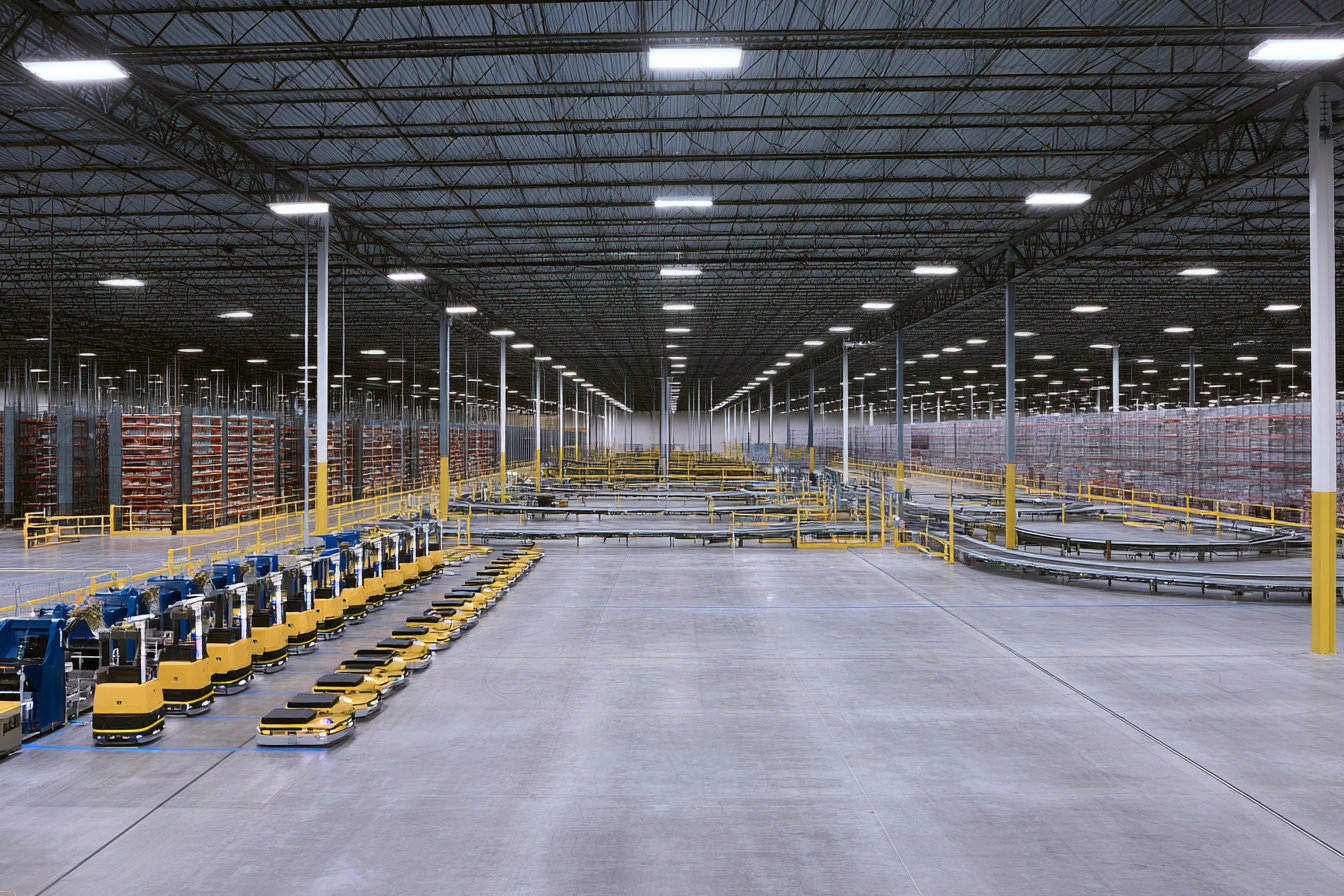
The biggest warehouse automation trends in 2026 are a shift in spending from hardware toward software and control layers, faster mid-market adoption, retrofits of existing buildings, practical AI on the warehouse floor, mixed fleets of robots and conveyors, real-time visibility, and automation as a response to labor gaps. Mordor Intelligence sizes the global warehouse automation market at about $34 billion in 2026, growing to roughly $66 billion by 2031. For most operations, the takeaway is to invest in phases and make sure the control layer can run whatever equipment you add next.
Introduction
Warehouse automation trends in 2026 favor operations that buy in stages and keep their options open. Buyers are more cautious about leading-edge technology than they were two years ago, and more focused on upgrades that pay back quickly in existing buildings.
This article is for operations, engineering, and supply chain leaders at mid-market distribution centers, 3PLs, and manufacturers planning automation budgets for 2026 and 2027. It covers the seven shifts worth planning around, which ones matter most at mid-market scale, and where the warehouse control layer fits into each.
What Are the Biggest Warehouse Automation Trends in 2026?
Seven trends define warehouse automation in 2026:
- Spending shifts toward software and control layers
- Mid-market adoption accelerates
- Retrofits outpace greenfield builds
- AI moves from pilots to specific floor tasks
- Robots and conveyors share the same floor
- Real-time visibility becomes a baseline expectation
- Automation and upskilling address labor gaps
1. Spending Shifts Toward Software and Control Layers
Hardware still anchors high-throughput facilities, but a growing share of automation budgets goes to software that coordinates equipment. Mordor Intelligence describes a gradual migration of spending toward software, with hardware remaining the core of high-volume sites. The practical result: buyers now evaluate the control and orchestration layer as its own decision, separate from conveyor or robot purchases.
2. Mid-Market Adoption Accelerates
Automation is no longer limited to enterprise distribution networks. Modular equipment, robotics-as-a-service pricing, and web-based control software let mid-market operations automate one line or one zone at a time. Industry research from A3 (Association for Advancing Automation) also shows demand spreading well beyond automotive, the sector that once dominated automation investment.
3. Retrofits Outpace Greenfield Builds
Most 2026 automation projects add to or upgrade existing buildings. In Control Engineering's 2026 State of Industrial Automation report, more than one-fifth of respondents said upgrades to existing automation made up 21% or more of annual capital spending. Retrofits mean mixing new equipment with old, which puts pressure on control software to run both.
4. AI Moves From Pilots to Specific Floor Tasks
AI dominates industry conversation, but adoption is getting more selective. The same Control Engineering report noted a nine-point shift toward more conservative adoption of leading-edge automation technology. Where AI is gaining ground, it targets narrow, measurable jobs: flagging equipment issues before they cause downtime, adjusting routing based on live conditions, and forecasting labor needs by shift.
5. Robots and Conveyors Share the Same Floor
AMRs (Autonomous Mobile Robots), goods-to-person systems, conveyors, and sorters increasingly operate in the same building. These fleets often come from different manufacturers, so the challenge shifts from buying robots to coordinating them with fixed automation. Equipment-agnostic control is becoming a buying requirement for this reason. Our guide to vendor-agnostic vs. proprietary WCS covers the trade-offs.
6. Real-Time Visibility Becomes a Baseline Expectation
Operators, maintenance teams, supervisors, and executives all expect live views of the floor in a browser, not end-of-shift reports. Role-based dashboards, severity-ranked alarms, and automated KPI reports are now standard asks in control software evaluations.
7. Automation and Upskilling Address Labor Gaps
Labor availability and cost remain primary reasons to automate. Reports from 2026 also point to the other side of the equation: as automation reduces repetitive manual work, operations need technicians who can troubleshoot PLCs, read I/O diagnostics, and manage software. Control Engineering's report recommends upskilling and cross-functional training to close that gap.
Which Warehouse Automation Trends Matter Most for Mid-Market Operations?
For mid-market facilities, retrofits, mixed equipment, and real-time visibility have the most direct impact on 2026 budgets.
- Retrofits: Plan upgrades so each phase works on its own and connects to the next.
- Mixed equipment: Choose control software that runs any manufacturer's equipment, so new purchases are not limited by what you bought five years ago.
- Visibility: Prioritize live dashboards and alarm history. They pay back quickly through faster fault response and fewer missed cutoffs.
- AI: Treat AI as a feature inside tools you already need, not a standalone project.
How Should You Plan Warehouse Automation Investments for 2026 and 2027?
Plan automation in phases tied to measurable bottlenecks, and lock in the control layer before you commit to the next round of equipment.
- Find the constraint: Measure where throughput stalls today, such as merge points, sortation, or labeling.
- Fix the constraint first: Automate or upgrade the zone that limits total output.
- Standardize control: Put all automated zones under one WCS (Warehouse Control System) with one set of dashboards and alarms.
- Measure payback: Track throughput, downtime, and labor hours before and after each phase.
- Expand: Add the next zone using the same control layer, regardless of equipment brand.
Budgeting for control software? Our warehouse control system pricing guide breaks down typical cost ranges.
Where Does the Warehouse Control System Fit in These Trends?
The WCS is the layer that makes every one of these trends workable, because it connects the WMS (Warehouse Management System) to the equipment and turns orders into real-time commands.
A WCS handles the real-time decisions a WMS is not built to make: routing by carrier or destination, merge control, labeling, and put-to-pallet logic. It also delivers the visibility and alarm handling that mixed-equipment, retrofit-heavy floors depend on. For a full explanation, read what a warehouse control system is.
FAQ
What is the future of warehouse automation?
Warehouse automation is moving toward software-coordinated facilities where robots, conveyors, and sorters from different manufacturers run as one system. Growth is strongest in software, retrofits, and mid-market adoption.
How big is the warehouse automation market in 2026?
Mordor Intelligence estimates the global warehouse automation market at about $34 billion in 2026, with growth to roughly $66 billion by 2031. Estimates vary by research firm and by what each includes.
Is warehouse automation worth it for mid-sized warehouses?
Often, yes, when it targets a measurable bottleneck. Phased projects let mid-sized operations automate one constraint at a time and prove payback before expanding.
How is AI used in warehouse automation in 2026?
AI is most often used for specific tasks such as predicting equipment issues, adjusting routing based on live conditions, and forecasting labor needs. Many operations now adopt AI as part of existing software rather than as a separate project.
Conclusion
The warehouse automation trends that matter most in 2026 point in one direction: phased investment, mixed equipment, and software that ties it together. Operations that lock in a flexible control layer first can add robots, sorters, and new zones without starting over each time. Book a ControlPoint demo to see how a web-based WCS fits your 2026 automation plan.
See How ControlPoint Can Transform Your Warehouse Floor
Schedule a demo and see if ControlPoint is the right control layer for your operation.